

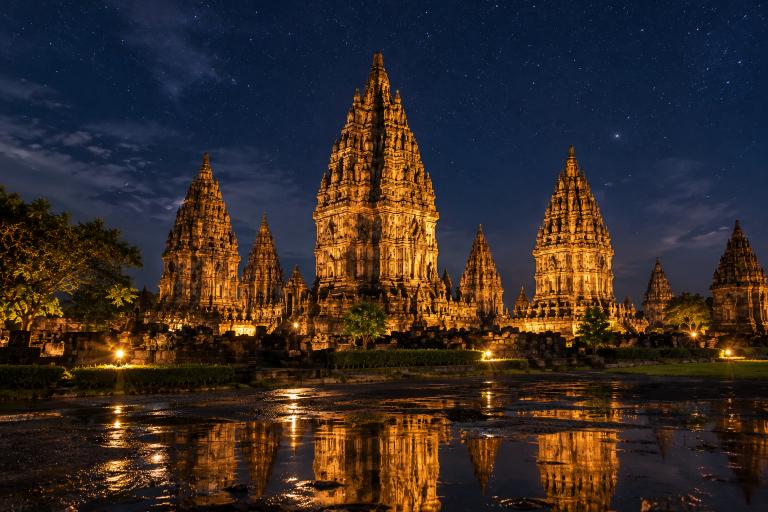
Prambanan Temple has a history that stretches back more than a thousand years. Built during the 9th and 10th centuries, this magnificent Hindu temple complex reflects the power and creativity of the Mataram Kingdom in ancient Java. The full story of Prambanan temple history reveals why the site remains one of Indonesia’s most treasured cultural landmarks.
The construction of Prambanan began during a period when Hinduism played a major role in Javanese society. The temple was built as a sacred center dedicated to the Hindu Trimurti: Shiva, Vishnu, and Brahma. The central shrine honors Shiva, while the neighboring temples are dedicated to Vishnu and Brahma. This arrangement represents the balance of creation, preservation, and transformation in Hindu belief.
The main Shiva Temple is the tallest structure in the complex, rising to about 47 meters. Its impressive height and detailed carvings show the extraordinary skill of ancient Javanese craftsmen. The builders used volcanic andesite stone, shaping each block carefully and assembling the structures with remarkable precision. Many parts of the temple were built without mortar, relying on carefully designed joints to hold the stones together.
Prambanan was not built as a single temple. It developed into a large sacred complex containing hundreds of shrines arranged in concentric zones. The most important temples were placed at the center, while smaller structures surrounded them. This design reflects Hindu cosmology and the idea of a sacred universe centered on divine power.
The walls of the main temples are decorated with reliefs from the Ramayana epic. These carvings tell the story of Rama, Sita, and Hanuman. They show how Indian religious narratives became part of Javanese culture, adapted through local artistic styles and traditions. The Ramayana reliefs are considered among the finest examples of stone carving in Southeast Asia.
Prambanan is also closely connected to the legend of Roro Jonggrang. The story tells of a prince who was challenged to build one thousand temples in a single night. When the princess tried to prevent him from finishing, she was turned into stone. This legend explains why the temple is also known as Candi Roro Jonggrang and adds a mystical layer to its history.
The glory of Prambanan did not last forever. Earthquakes, volcanic eruptions, and political changes contributed to the decline of the complex in the early 11th century. Many temples collapsed, and the site was gradually abandoned. Over time, vegetation covered much of the area, and the temples remained hidden for centuries.
The complex was rediscovered in the 17th century, but major restoration efforts came much later. Restoring Prambanan has been a difficult process because many original stones were damaged, scattered, or lost. Experts have worked carefully to return the stones to their correct positions while preserving the historical authenticity of the site.
In 1991, Prambanan Temple Compounds was inscribed as a UNESCO World Heritage Site. This recognition highlights the temple’s outstanding architectural value, religious significance, and artistic achievement. The protected area also includes nearby temples such as Sewu, Lumbung, and Bubrah, reflecting the coexistence of Hindu and Buddhist heritage in ancient Java.
Today, Prambanan stands as a powerful reminder of Indonesia’s rich past. It attracts travelers, researchers, photographers, and spiritual visitors from around the world. Its history is not only a story of ancient kings and craftsmen but also a story of survival, rediscovery, and preservation. A visit to Prambanan allows people to experience firsthand the grandeur of Java’s Hindu civilization.
